Interested Students

About

Simulation - Innovation - Action
SIMUVACTION consists of TWO main events:
- a simulation
- a symposium
* A SIMULATION (Wednesday, March 24, 2027):
Would you like to experience being a Head of Government, Journalist, or Stakeholders? Do you want to see how YOU can impact negotiations? Would you like to draft an international level recommendation report on important policy? If so, join us for this exercise replicating a meeting of the Global Partnership on Artificial Intelligence’s (GPAI), be ready to truly invest in your role and stand for the position of your stakeholders !
SIMUVACTION is an opportunity for 40 university students from across the world to actively engage, practice, and contribute to an exercise of global governance on AI. Students, coming from different fields, universities, backgrounds, and countries will train for 14 weeks through a common course in which they will receive the support of professional partners.
-
WHO ?
International and interdisciplinary student teams, typically composed of two participants, including graduate students from diverse backgrounds.
-
WHAT ?
Each team is assigned a role—such as national delegates, journalists, or stakeholders—and engages in a simulation where they research, debate, draft a text, amend, and vote on actionable policy recommendations.
-
WHEN ?
From January 19, 2027 to April 16, 2027 - The entire process culminates on the designated “D-Day,” with the challenge to submit the final adopted recommendations by 5:00 PM (see the timeline below).
-
WHERE ?
Supported by a network of academic institutions, NGOs, associations, private and non-profit sectors, diplomatic teams, Simuvaction is organized online except for a week where we meet in person.
-
WHY ?
-
To discuss together on AI global governance
-
To learn and experiment professional skills
-
To be out of our comfort zone, and build our character
-
To thrive together, and realize that beyond our differences in cultures, countries, background, fields of study, we can build together, think globally and act locally
-
After attending Zoom conferences, preparing the roles they are assigned, students will meet in-person for a five-days session - they have to advance the position of the entity they represent and to successfully create an agreement that illustrates the interest of all parties involved.
International and interdisciplinary student teams, composed of two participants each, are assigned specific roles such as national delegates, journalists, or stakeholders. Immersed in their roles, these teams are expected to research, debate, draft, amend, and vote on one of the most pressing ethical challenges in artificial intelligence: how can we ensure that AI does not inadvertently exacerbate disparities on a global stage?
This EXPERIENTIAL LEARNING PROGRAM is mainly designed for graduate students but welcomes undergraduates in their last year. With support from academic institutions, private and non-profit organizations, NGOs, associations, and diplomatic entities such as Consulates and Embassies, participants will collaboratively develop and vote on actionable policy recommendations by 5:00 PM on the designated "D-Day."
* A SYMPOSIUM (Thursday, March 25, 2027):
Global Governance of AI Infrastructure :
Data Centers on Land, at Sea, in Space, and beyond
(More to come)
Partners and Stakeholders
2025-2026

Objectives:
CREATE AN ECOSYSTEM
The Simuvaction exercise is conceived as a way to create an “ECOSYSTEM” through multi-layered objectives - from active learning to international thinking - with stakeholder representatives coming to an accord on common interests regarding Digital Matters applied to Health Care.
An exercise for STUDENTS to practice "ACTIVE LEARNING"
-
fills the gap between their studies and the professional world
-
offers them an opportunity to discover themselves, out of their comfort zone, on a professional stage
-
enhances the links between knowledge, ways to do and ways to be, through multi-disciplinary teamwork
A way to consider COLLABORATION between ACADEMIC INSTITUTIONS
Through the preparation and the simulation game, collaboration between different academic partners is under way. We hope that the simulation will be a great milestone in strengthening and expanding such partnerships in Higher Education.
A way to DEVELOP INTERNATIONAL THINKING
The project aims to reflect the “THINK GLOBALLY, ACT LOCALLY,” motto. We consider that “local problems have global connections and implications, and these problems cannot be solved by individuals in a single country” (see NAIR Indira, WHITEHEAD Michele, Models of Global Learning, 2017, v).
Thinking globally requires both a sense of identification and enhanced creativity in problem-solving to truly think and engage in global problems.
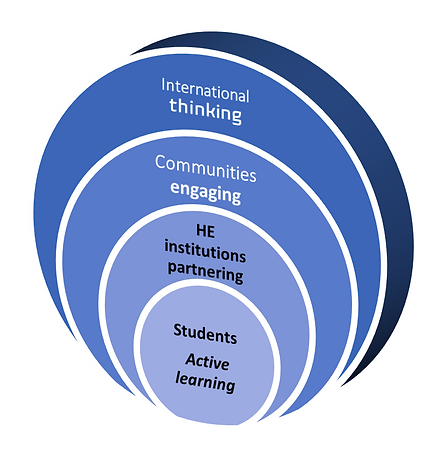
A way to ENGAGE with COMMUNITIES
-
It strengthens connections between academic, economic, institutional, and non-profit actors
-
It provides an opportunity to work through the different facets of an issue by participating in conferences with experts in the field, by creating contacts with the Consulates of the represented delegation, and by coaching from lobbyists-teams with businesses, associations, and NGOs
Timeline

In enrolling for this program, students must accept the role they are assigned, attend the conferences and the virtual/in-person events, turn in the assignments on time, as a preliminary condition for receiving the certificate of attendance/ to valid the exercise as an independent study course
ENROLLMENT
NEW for SIMUVACTION 2027!
Please note that the application and enrollment process has changed.
Review the updated requirements and key dates below.
-
Applications: Applications must be submitted between September 21 and October 21, 2026. Your interest (CV and motivation to invest time for experiential learning in English in a multidisciplinary and international context) and according to your home university, other criteria defined by your home university) must first be reviewed and approved by a faculty member at your home university.
-
Registration form: Once your application has been approved, your faculty member will provide you with the registration form as confirmation of their endorsement. Please complete the form with your personal details and submit it as instructed.
-
Interview: Admission to the program is subject to a brief interview with a Simuvaction alumnus/alumna. Interviews will take place between September 28 and October 26, 2026. The interview will assess applicants' commitment to the program, ability to work in a team, familiarity with AI-related topics, and English proficiency (minimum C1 level). No language certificate is required, but applicants must be able to participate comfortably in a full conversation in English. Final admission decisions will be communicated on November 1, 202
-
Enrollment Fee: Upon receiving confirmation of your full acceptance on November 1, 2026, you must pay the registration fee between November 2 and November 10, 2026, according to your country of residence:
-
Band A: USD 100
-
Band B: USD 50
-
Band C: USD 25.
-
-
Travel and Accommodation for the in-person session: Students are responsible for securing funding for their travel expenses, including airfare and, where applicable, visa costs. Applicants are encouraged to seek support from their home university and other potential sponsors when available. Accommodation will be provided by the program for five nights, including breakfast, based on double-occupancy rooms shared with a participant of the same gender. Participants are responsible for their own meals and personal expenses throughout the program, except for lunch on Wednesday and Thursday, which will be provided by the organizers.
Kick-Off Meeting : January 19, 2027
Stage 1 January 19 - February 22: Zoom Conferences
Stage 2 February 22- March 23: Role assignment -
In teams of 2 students, play roles, meet other teams, draft the final text, post on social media, do the assignments
Stage 3 March 21-March 26: 5 days in Gainesville, University of Florida, FL, USA -
In-person attendance to all events.
-
Arrival for International Students in Gainesville, Florida on Sunday, March 21 at the latest
-
Monday, March 22 (9-1 p.m.): Negotiation exercises - and team activities in the afternoon
-
Tuesday, March 23 (9-1 pm): Negotiation exercises
-
Wednesday, March 24 (8.30 am to 6. pm): the ACTION-DAY!
-
Thursday, March 25 - Symposium
-
Friday, March 26 - End of the 2027 In-Person session
Stage 4 April 16, 2027 (via Zoom) : Feedback: What lessons? What did I learn? What are the next steps to develop my personal character?
And then, for the alumni, a new "Alumni Pathway" to allow students to grow and develop their responsibilities through time and recognition, with Faculty Board members within SIMULED.
Sponsors 2025-2026
This project/publication was made possible through the support of a grant from The Wake Forest University and the Lilly Endowment, Inc.
The opinions expressed in this project are those of the author(s) and do not necessarily reflect the views of Wake Forest University or the Lilly Endowment, Inc.


FOLLOW US
Follow us on
Simuvaction


Frequently asked questions
MEDIA

Simuvaction on AI - 2026 - "AI and the future of Education" - "AI and the customization of education"
ISEP, Paris, France
Simuvaction on AI - 2025 - "AI and the Augmented worker" OBVIA, Université laval,
Québec, Canada
-
See the video: https://youtu.be/lT8eLupGLR0
SIMUVACTION on AI 2024 - "AI and Climate Resilience" Emory University,
Atlanta, USA
* See the slideshow with pictures -
* See the video
* See the clip -
* See the article published on the Website of the University Federale Santa Cantarina, Brazil - for the first participation of a Brazilian University to Simuvaction and celebration of our student Suliane Motta
SIMUVACTION on AI 2022 - Emory University
-
see "The best kind of challenging, Emory students join international simulation to debate AI and health inequities" in The EMORY REPORT, January 2023
-
see "Simuvaction 2022- Intelligence Artificielle et Ethique", in La FRANCE AUX ETATS-UNIS, Consulat Général de France à Atlanta, Decembre 2022


From 2015 Students from Nantes University participated in a European Council simulation
In 2017, the Program won the "Passion on Teaching in Higher Education" from the French Ministry of Higher Education, Innovation and Research - the PRIX PEPS
-
The 2018 simulation on "Bioethics and Regenerative Medicine" : https://www.youtube.com/watch?v=jUVTnHdD7cU


Pictures Credit: Jack Wang, Alexandra Blank, Samuel Sanchez, Olivier Menard

Contacts

For more information
Dr. Anne-Elisabeth Courrier
Affiliated Faculty, Emory French and Italian Department, Emory University,
Associate Professor in Public Law,
Political Sciences and Law Department
Nantes University
SIMUVACTION is a program delivered by the Association/Non-profit SIMULED,
registered in France with US registration.
